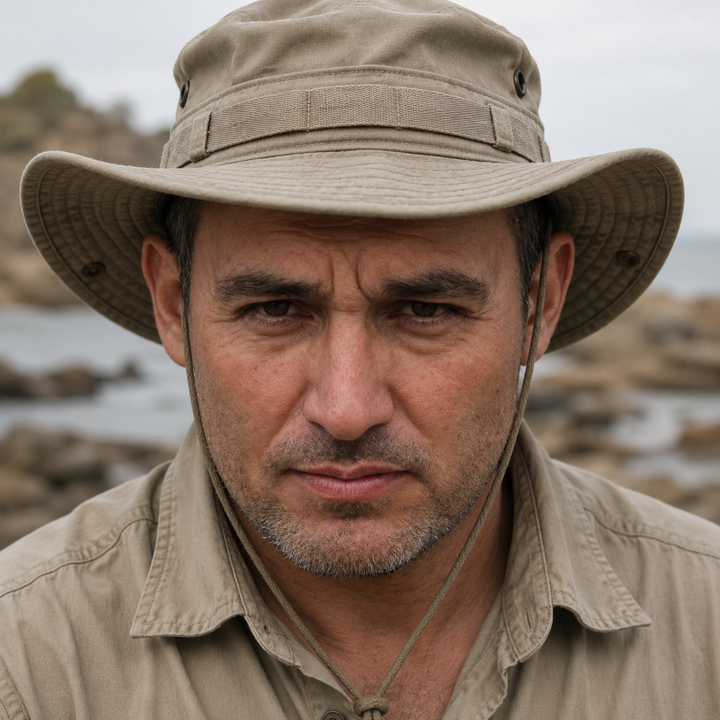
| Entry 7 | Mavis Island — Meeting the Mavisians |
Published:
After dinner, 2000
My research trip to Instrument Station 030 was an overwhelming success. I’ve returned to Base Camp with five full canisters of malopitic sediment. The haul should set me up with lab work for the next month, at least.
The end of the electrical storm coincided with the end of the filbospheric downdraft. The interior of the hut at the field station was of course unharmed, as the tecolyte panels and reinforcement beams in the interior are designed to prevent any harm to the researcher taking refuge inside the hut. And the baryllic exhaust fan assembly was entirely undamaged, as the filbo bulge it emits is powerful enough to instantly cut through any size chunk of hail like a warm knife through butter.
When I pushed the door open first thing today, however, I was again in awe at the power of nature. The morning sky was a magnificent shade of turquoise with crimson streaks like paintbrush strokes where lightning had screeched through filbospheric rays. The air smelled like cinnamon and there was a perceptible but indescribable mist kissing my skin like invisible sea foam.
The Mitsubishi two-door was knocked back a couple dozen feet, and sat stuck in the mud near the crest of the steep hill leading from the Instrument Station. A long, comet-shaped scar in the mud drew a bold line from where the field vehicle now lay, perpendicular, to where it had began in the driveway in front of the hut and baryllic exhaust fan. The vehicle itself didn’t seem damaged, but the passenger side of it, which had faced all the excitement from the large piece of hail that was now completely melted, sat under a bank of mud that was a meter tall and looked like a brown snowdrift.
I wiped my brow with a bandana, unrolled my small dry bag to retrieve a University-issued Blackberry, and called the only saved number. “Yeah, Professor Lopez?” I listened. “I’ve been through worse.” I listened. “No, I can’t drive it.” I listened. “It’s turtle soup here.” I listened. “I can wait.” I listened. “No problem.” I listened. “You too.” I hung up.
It would be noon by the time they could get a vehicle with a cinch through the wrecked trails. That was fine by me. I had plenty of rations and oil lamp fuel, in case they didn’t make it that day after all. But I decided to explore on foot. There wasn’t any use trying to analyze the canisters of malopitic sediment, as Instrument Station 030 had entered a post-storm reboot cycle that would have rendered any sample exposed to a non-horomitic panel useless.
I packed some water, food, and basic medical supplies into my pack and set off down the hill. I hadn’t spent much time exploring the island, apart from our scientific missions. And those took a quite masculine and somewhat aggressive posture, though I was starting to wonder the impact of the international scientific community on the local society and ecosystem.
The hill was extremely steep at first, and the rocks and sediment were quite loose this late in the season. I found myself slipping here and there. Best not to look down, in situations like that. The best advice I ever got, one day a long time ago in the French Alps, was that if you suddenly found yourself face over feet over face, it’s best to rotate over so you’re staring into the hill rather than up at the sky, and start stabbing your feet and hands like daggers into the side of the hill. Facing down, and trying to slow your movement, you have a much better chance of surviving your confrontation with gravity. Your prizes might get damaged in the process, but at least you’re alive.
The steep hill soon flattened into a broad basin and the shoreline of a nice little bay peeked around from behind a dense patch of foliage. The clouds, too, appeared much less threatening and more like Spring Break. There were surprisingly leafy trees, given the latitude, and the foliage bordered a flat, white, sandy beach. It was much less rocky than Dagano Bay and most of the places I had scoped out during my rides around the island. It was strange. I swear I could hear the bells of my little sister’s gérain as she used to splash around the beach near Calvois where our parents used to take us.
I was exhausted by that point, possibly staggering, when I encountered two twenty-something Mavisians sitting on wicker chairs and holding aloft their small mugs of, likely enough, gertis gertis tea. What I could see of their house behind them, as it was half buried, as was typical of Mavisian dwellings, looked something like a retro aluminum camping trailer. But I knew the underground structure was much larger and more architecturally complex.
I waved at them like stamps on a postcard I had kept far too long on my refrigerator. What would I say to them? What if they wanted to know what I did? I kept waving. What if they didn’t understand, and I found myself tensely defending what little world I knew from the University? I kept waving.
At some point they stopped waving and gestured to a folding metal and plastic lawn chair that sat empty next to their wicker versions. They appeared to have just woken up. Neither were wearing shoes. Their shaggy, wavy hair was chaotic, and their week-old beard stubble was patchy. One was wearing a pair of khaki cargo shorts and an old, faded unbuttoned short sleeve shirt. The other had on faded blue jeans, which he had zipped up but no yet bothered to button, and a t-shirt that simply read “Quoi?” I wondered the same thing myself.
I walked over to the open chair and gestured to it, not sure if they spoke English. “Go ahead, science man,” the one in the cargo shorts said.
“Yes, thank you, I am grateful,” I said awkwardly as I stepped over the plastic cooler the one in jeans had his feet on and landed in the chair. “I’m Pierre, by the way.”
He took his feet off the cooler. “There’s some tea in there if you’d like some,” he said, adding, “I’m Caleb.”
I nodded at him, possibly slowly enough it betrayed the fact that this was my first encounter with Mavisian natives and was a bit surprised to hear his English name.
“And this is Kyle,” Caleb offered, “if he’s not going to say hi himself.”
Kyle coughed. “Sorry chums, the gertis went down the wrong tube, as it were, had to shift gears for a moment there.” He offered his hand for me to shake. It was rough and callused, and he was strong even though he didn’t squeeze my hand overly hard.
“What do you do?” Caleb asked.
“I work for the University,” I said as I dug through the cooler looking for a canteen of tea and a clean mug. Caleb and Kyle didn’t respond. “Oh, that’s the University of—“
“I know what the University is,” Caleb interjected, “but what do you do for it?” Kyle lethargically waved at a large baltus sphyxis fly that had overstayed its welcome on the shoulder of his unbuttoned shirt. It fluttered away with equal drowsiness.
“Well, I’m the Baryllisman on this year’s research trip,” I said, realizing halfway through they possibly didn’t know what a Baryllisman was. I explained: “In the field I’m responsible for operating carbonalturers, or whatever manner of devolting instrument is required given the conditions. And I also collect samples of filbospheric excrement and generally any type of stimulus exopilis, or any kind of stimulus, really, which we use to induce malopitic flattening.”
They stared at me for a couple seconds. “That’s cool,” Kyle exhaled finally. “I’m a carpenter. I don’t know anything about the kinds of primitive houses the University puts you in, but I stay busy working for my people. Especially in the cold months, when we stay mostly indoors and underground.”
I was floored by the beauty of the Mavisian way, but starting to wonder if I was playing the role of the Piègais conquerer. “And what do you do?” I asked Caleb.
“Baker.”
The sun had burned through the crimson streaks that had colored the early morning sky and we were left with a beautiful, cloudless pale blue sky. I sipped my gertis gertis tea and bent down to unlace my boots. I was reminded of a question I meant to ask if I ever found myself in such as situation: “Say, you may know. After the storm that hit on the day I arrived a few weeks ago, I forgot to wash off gertis gertis discharge quickly enough, and I developed some skin lesions. They had me drink gertis gertis tea, which helped my skin heal faster. What manner of science is behind this?”
Caleb chuckled. “They don’t know?” I shook my head. “It’s loaded with antioxidants. There are some antimicrobial and antiseptic benefits too. Not too complicated.” He paused and gave me a studied look. “Say, science man. You weren’t up in that tiny hut last night during the storm, were you? That one there, on the bluff?” He pointed in the direction I had come from.
I nodded as I swallowed gertis gertis tea. “I didn’t adequately review the weather data before leaving our compound on the north side of the island.”
“You didn’t hear what happened on a few of the Rable Islands when that front moved through a few days ago?” Kyle asked, suddenly aroused from his half slumber.
I didn’t need to nod this time. They burst out laughing, and I couldn’t tell whether it was in mockery or some form of awe and respect. Possibly it was a combination of the two.
“Whatever they say about you Pierre, you’re no coward, in constant need of support and rescue.”
I laughed with them. “In my childhood, in Calvois, my father Jean-Luc would always say, now listen here Pierre. In the Delgado family we don’t raise glue pots.”
Caleb snapped his fingers. “Oh, you’re from Piègais. Yes, I know the term from your movies.”
Kyle shook his head and clicked his tongue. “I can’t believe what the University throws at you researchers,” he said. “How that little hut survived the storm, exposed on that bluff, is beyond me.” I told him about the tecolyte panels and the hexagonal support beams. He sighed, saying, “they must not have told you how often they replace that little hut. I walk by sometimes, after a storm, before they bring the big truck with a new hut, and see the old one flattened like a cardboard box headed for recycling.”
Now I had that to worry about. I was just about to ask them more about what the University had gotten up to on the island before my recent arrival when I heard the horn of a field vehicle being honked from the bluff. I took my University-issued Blackberry out of my pocket and saw I had ten missed calls from Professor Lopez. I also saw I had been drinking tea with Caleb and Kyle for over an hour.
I stood up, and they rose to shake my hand. “Caleb, Kyle, boofret cherowah.”
“Boofret, boofret,” Caleb said. Kyle sat back down and opened the cooler again.
The trip back was mostly uneventful. I told Professor Lopez about the Mavisians I had encountered, but didn’t tell her all we talked about. I said we had mostly discussed cultural differences and movies from the mainland they get over the airwaves. Dinner was especially comforting that night. I devoured two servings of egg and cucumber dumplings, a half a tray of bread pudding, and a cup of tortus sorbet.
I know one thing: Pierre Delgado will sleep tonight. In that whole episode I realized how far away from my fiancée I was, from her Castonellan mystique and unrelenting beauty. I will visit her in my dreams tonight.
Signing off, it’s 2030. Enjoy some Eagle-Eye Cherry, a favorite of mine and Maria Francesca’s, and the last song we listened to in the car on the way to the airport the day I flew here.
All glory to the University.
Pierre Delgado
Well, we know I’m goin’ away
And how I wish, I wish it weren’t so
So, take this wine and drink with me
Let’s delay our misery
Save tonight and fight the break of dawn
Come tomorrow, tomorrow I’ll be gone